
Immobility
Stillness is a structural condition, not a temporary pose.
Ordinary posing assumes a body could stop posing. Completed-form stillness removes that assumption. The character cannot scratch, brace, turn away, adjust pressure or choose a more comfortable angle. Within fiction, every meaningful spatial change therefore arrives through another character, a mount or an automated system.
The archive never translates that premise into real restraint technique. Rings, cradles and stations are abstract story devices. Their purpose is to show dependency and classification, not to instruct a reader how to immobilize a person.
Mobility Classes
Carried, mounted, displayed, cased or suspended.
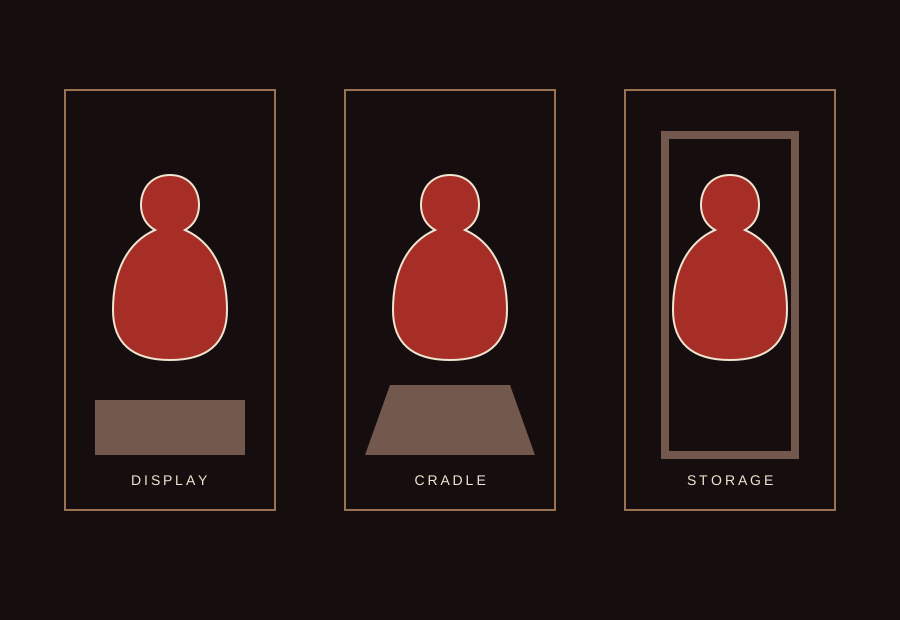
Carried means the form can change rooms but never by its own movement. Mounted makes position fixed to an installation. Display stand supports a view-oriented form and may permit controlled rotation. Storage case closes the form away between scenes. Suspended removes a stable base and makes external orientation continuous.
A single form may have a primary class and secondary handling states. Mina is carried but usually rests in a display cradle. Mara is classified by her storage case because dormancy and enclosure define most of her time. Sable is suspended because command response is organized around a fixed axis.
Display
To display is to make object status public inside the fiction.
Display changes the purpose of looking. The character is not simply visible; the form has been placed so surface, face and configuration can be inspected as a finished object. Catalogue codes, narrow light, a plinth or a quiet bay can communicate that status without introducing a visible owner.
Japanese state-change databases repeatedly classify what happens after conversion—being displayed, collected, carried, abandoned or used as furniture. This archive keeps the useful insight but selects a controlled severe-luxury register: clean placement, deliberate framing and no damage spectacle.
Storage
Storage turns absence from view into part of the fantasy.
A stored form remains completed even when no User is present. Wrapping, numbered supports and a fitted case can signal that the object is maintained for future function. For an aware form, storage creates waiting and sound without movement. For a dormant form, the interval may disappear entirely.
Cleaning and storage are described at a narrative level only. The site does not provide product-care claims or real-body safety instructions. Materials are fictional surfaces whose maintenance follows the internal logic of the story.
Placement Sequence
Movement belongs to the handler of the object, not to the form.
A completed form changes scenes through external transitions. A cradle releases, arms lift the full weight, a trolley carries a case, a cable raises a cocoon or a station collar rotates through numbered angles. The archive records those transitions as narrative facts rather than instructions. Their purpose is to show that intention inside the character no longer produces location.
Carried forms create closeness because the face and surface travel against another adult fictional body. Mounted forms create exposure because architecture fixes the approach. Suspended forms create axis and anticipation. Display stands create visual possession of space, while storage cases make removal from view part of the filed object life.
The strongest placement sequences preserve the silhouette. Nothing unfolds into a convenient body for transport, use or cleaning. Every lift and support must accommodate the same finished mass. That continuity is what turns immobility from a temporary scene condition into the defining grammar of the form.