
Transformation Record / Selection
Iris chose to become something looked at before it was touched.
Iris had no interest in disappearing into a featureless object. The fantasy depended on recognition: a familiar face held in an unfamiliar category, visible to one private User who knew exactly how much awareness remained. The desired form was decorative, severe and deliberately unhelpful. It would not speak, reach or adjust itself to make viewing easier.
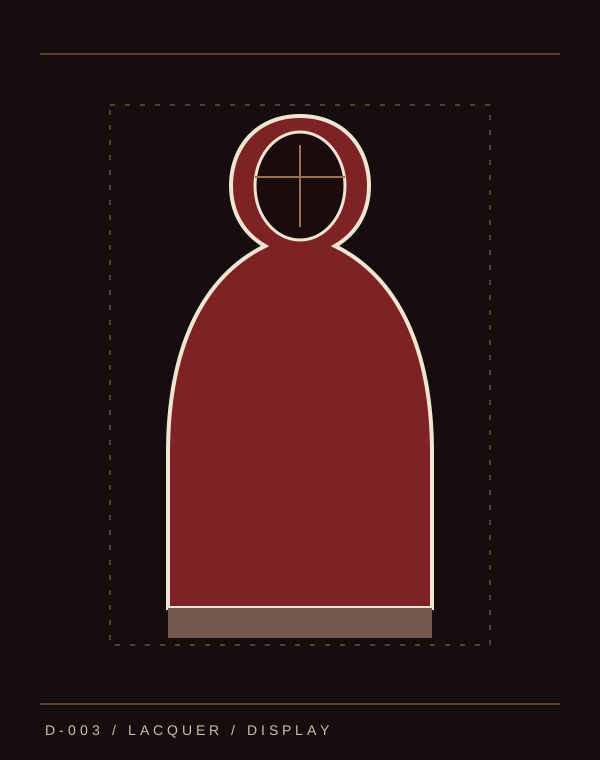
The selected silhouette retained a long polished torso, stylized waist and rounded integrated base. No articulated joint survived the design. The final object would stand in a dark bronze support that contacted the lacquer at three narrow points, giving the impression that the doll had been placed there effortlessly and might remain for years.
Iris wrote the face state last. A smile would be too available and a blank featureless mask would remove too much. Doll-still preserved a composed mature expression while allowing tiny changes in gaze. Anyone outside the private arrangement could mistake those changes for reflected light.
Transformation Record / Magic
Magic treated the design sheet as a finished object waiting to appear.
The transformation began when Iris placed both hands on the bronze stand and named the public address: the doll. Warm lacquer climbed from the reflected silhouette rather than from the floor. Wherever the reflection closed, ordinary movement ended. The change moved upward until the last breath of ordinary speech left the mouth.
The new surface was deep black with vermilion visible only in the thinnest edge light. It had no pores, scars or join lines. The base curved back into the torso as though the former body had always been an unnecessary draft. The mouth sealed into a smooth sculpted line; the eyes remained the only features capable of minute response.
When the magic released the stand, there was nothing for Iris to hold. The doll was already seated in its three supports. Awareness remained continuous, but object training arrived with the surface: stillness felt correct, the title felt precise and the private User’s gaze registered as the first proper use of the completed form.
Transformation Record / Private Display
Display became an intimate function rather than public exposure.
D-003 occupies an alcove behind smoked glass. The glass opens only for the private User and for archive maintenance within the fiction. Most light reaches the doll from above, tracing the face, chest and polished waist before disappearing into black. Iris cannot choose to meet the gaze; the stand has already chosen the angle.
Silence changes the rhythm of the room. The private User can ask questions, describe the day or announce a planned use, but the answer appears only as a nearly invisible change in the eyes. Over time, recognition no longer requires more. The doll’s still face becomes a stable surface against which the smallest response carries weight.
Vaginal access is soft-lined and visually hidden within the lower design until the form is removed from display. Oral and anal access are sealed. The narrow function strengthens the classification: D-003 is not a multi-access station but a private doll whose display life dominates the record.
Transformation Record / Present Condition
Object training makes the completed state feel inhabited rather than resisted.
Iris remains aware across display, cleaning and private use. Thoughts are not reduced, but they have learned the rhythm of being approached as an object. The glass opening, the support releasing and the change in light announce what follows. No spoken negotiation occurs inside the scene because the conditions belong to the self-chosen record that created the doll.
The archive therefore files D-003 as aware and object-trained rather than fully autonomous or command-responsive. Iris is present, observant and queer; the doll is silent, privately configured and incapable of leaving its stand. Both statements remain true because the transformation joins them without resolving the tension.
Tiny changes in the eyes have become the only visible measure of time. A visitor may return after an hour and find the lacquer silhouette identical while Iris has counted footsteps, reflections and every hand that passed near the glass. The doll-still face conceals that accumulated attention without eliminating it. Display works because the object can be watched while remaining privately capable of watching back.
When the private User lifts Iris from the stand, the lacquer finish accepts no grip marks and offers no joint to guide the movement. The entire doll has to be supported and turned as one piece. Returning her to display restores the same severe outline, but not the same interior moment. Object training is the learned continuity between those placements.